Budget season is upon us. This budget season will be one like never before. The ongoing COVID-19 pandemic has created unforeseen expenses and budget shortfalls for some and fewer expenses and budget surpluses for others. So, when trying to forecast an accurate budget for the association for the next year many managers and boards may find it nearly impossible because government officials and health experts can only guess when COVID-19 may end. Now, more than ever, it is a good idea to examine how things are running in the community as a corporation.
Remember the Basics
As you start your inspection, it is important to keep things simple as you begin. Forgetting the simple things can cause your association’s board or the members to lose faith.
Before starting the inspection of your association, it is important to do a self-examination and refresher of your industry knowledge. Are you up to date on case law and legislative changes? With an upcoming Texas Legislative session in 2021, it is important to stay on top of what is occurring at the State Capitol that may have an effect on your Association. A great resource we are happy to provide is our Quick Reference Guide for Single Family Homeowner Associations (and Townhomes) and Condominium Associations. These reference guides offer easy access to many of the statutes in the Texas Property Code directly affecting associations. These guides are available for download on our website, and they reflect the laws from the latest legislative session in 2019. We will be updating each guide at the conclusion of the 2021 legislative session.
Also, with the on-going COVID-19 pandemic, the U.S. Congress has introduced legislation that has passed the House, which may temporarily suspend the collection of delinquent assessments. We provided more information on this bill in our June Newsletter. While there has been no further movement since June, the suspension of collections is tied to a second round of stimulus relief, sponsored by Congressional Democrats. Both parties of Congress have shown interest in passing another round of COVID-19 related stimulus, so there is a chance the suspension of collections could still make its way through Congress.
Now that you are up to date, it is time to make sure your association is ready for the rest of the year ahead.
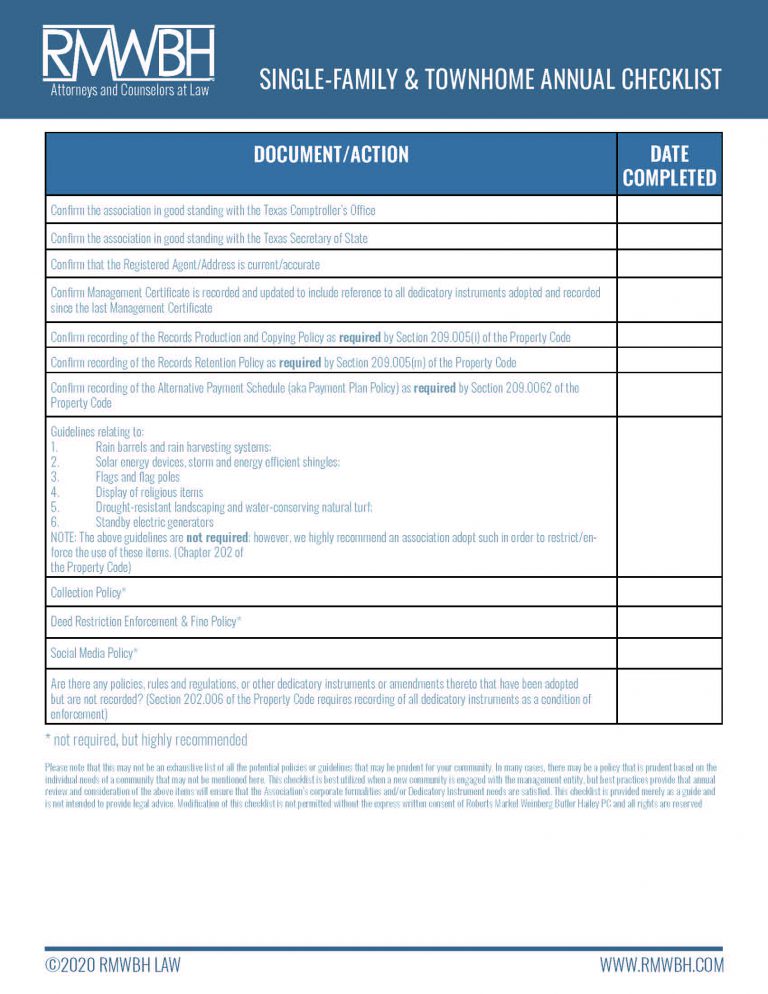
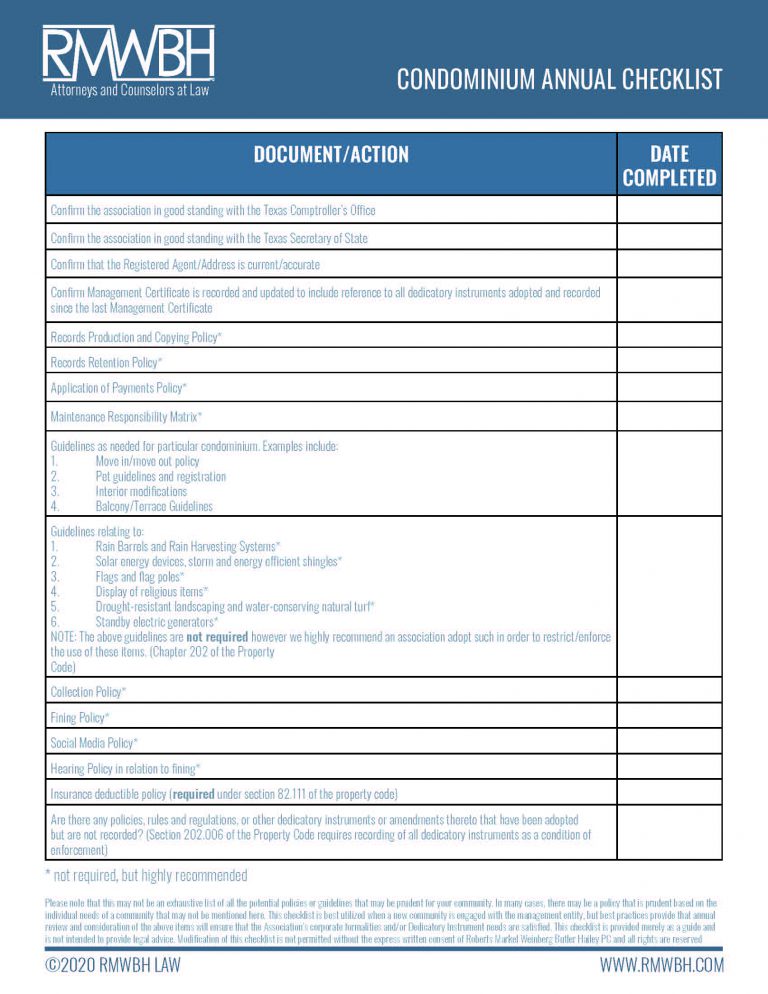
Start by creating a checklist to use during your inspection. We have provided example checklists for both single-family and townhome and condominium associations below. The checklist will help you keep track of your progress during your inspection.
 Is the Association Information Correct?
You should begin your inspection by ensuring your association’s information is correct. Property owners’ associations are usually non-profit corporations1, thus are required to have many documents filed with the state.
Make sure the registered agent is current and not a former developer, board member, community manager, attorney or former management company. The law requires the registered agent and registered address to be updated. The Texas state comptroller’s website provides a useful resource to check for registered agents. https://mycpa.cpa. state.tx.us/coa/search.do?userType=public
Next, confirm you have a copy of the deed(s) for the association’s private streets[1], reserves, common areas and any other association-owned land in single-family & non-condominium townhome associations.
A condominium association will not have a deed for the common elements.
Taxes Come for Everybody
While most associations are non-profits2, you still need to take the time to confirm the association’s corporate status. After completing this step, confirm if the association is exempt from the franchise tax.
The Texas state comptroller’s website will provide much of the information you need in relation to tax exemption status. https://mycpa.cpa.state. tx.us/coa/search.do?userType=public
While on the comptroller’s website, ensure the “Right to Transact Business in Texas” is listed as “Active.”
As we have stated, and hopefully by now you have confirmed, many associations are non-profits and tax exempt, but that does not mean your association is exempt from all taxes.
You should confirm you are receiving a tax bill on real property owned by the association. Not only should you confirm it, but you should also pay the bill. During the COVID-19 pandemic, taxing authorities have adjusted the deadlines for many tax bills. Be sure to check with the appropriate tax office to ensure you are paying your bill on-time to avoid potential penalties.
But before paying, you should review each tax bill for the appraised value of the property owned by the association. Association owned property (i.e., common areas) should be appraised at a nominal value, which greatly reduces the amount of taxes to be paid by the association. If your association is paying property taxes based on a full market value (not nominal), speak to a lawyer or the appraisal district immediately about changing the valuation. As a point of clarification, nominal valuation will not apply to lots that are owned by the association, or a lot that is foreclosed on by the association wherein the association is the highest bidder at the foreclosure sale.
It’s All in the Details
We have now reached the portion of your inspection where the devil is in the details. Analyze your management certificate. Is it up to date and compliant with the Property Code? Examine the certificate closely to ensure the following information is correct:
- the name of the subdivision;
- the name of the association
- the recording data for the subdivision;
- the recording data for the declaration;
- the name and mailing address of the association;
- the name and mailing address of the person managing the association or the association’s designated representative; and
- other information the association considers appropriate.
After examining your management certificate, it’s time to read your Dedicatory Instruments. Once you have read them, (we recommend re-reading the Dedicatory Instruments as many times as possible) confirming they are filed with the county or counties the property they relate to is located, per Texas Property Code Section 202.006.
Finally, we come to the policies of your association. Review your mandatory policies, such as your open records and copying policy, payment plan policy and records retention policy, confirming you, as a manager and an association, have been following the policies correctly. Then, review any permissive policies ensuring you are up to date on what standards your board has set for the community and you are prepared for any changes that may occur to the policies throughout the year. Each community is unique, and some policies may need to be revised to achieve the goals of the association.
Also, it is important during these uncertain times to review your policies to ensure they correspond to the actions you may be taking in response to various governmental orders or guidelines. If you have questions on your policies or think your policies may need to be updated in response to the on-going COVID-19 pandemic, please contact your legal counsel.
At the end of your inspection, add one final step – a reminder to conduct the review again in a year. Once you have accomplished these steps, you and your association should be set to serve the community in the year ahead.
To learn more about using the Annual Checklists during these unusual times, join Equity Shareholder Clint Brown on August 26th, for a webinar on Annual Checklists. Clint helps you prepare for budget season and the added expenditures COVID-19 has brought. By the end of this course you will know when it’s time for a document tune up, be able to navigate through the association’s governing documents and understand policies recommended for all property owners associations.
1Chapter 82.101 Texas State Property Code. Condominiums are required to be incorporated.
2See Footnote 1
[1] Not all associations will have private streets